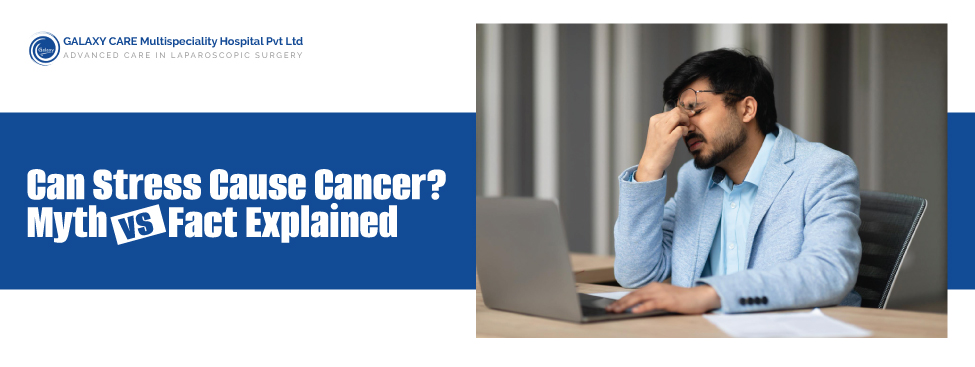
Can Stress Cause Cancer? Myth vs Fact Explained
Imagine you have had a rough few months at work, family stress has been piling up, and you have barely been sleeping. Then someone around you mentions that stress can cause cancer, and suddenly your mind starts racing. You go online, read a few articles, and by the end of it, you are more anxious than before.
One of the most common questions our cancer specialists in Pune hear is whether stress alone can really lead to cancer, or if the connection is often misunderstood. So, let us take a closer look at what medical science actually says about stress and cancer.
What Happens to Your Body When You Are Stressed?
Stress is a natural response. When you feel threatened or overwhelmed, your body releases hormones like cortisol and adrenaline. Your heart rate goes up. Your muscles tighten. Your body is preparing to respond to a challenge.
In short bursts, this is completely normal and even helpful.
The problem starts when stress becomes a constant state. Chronic stress, meaning the kind that stays with you for weeks or months, begins to wear the body down over time. It disrupts sleep patterns. It weakens the immune system. It affects how you eat, how much you move, and how well your body recovers from daily damage.
Long term stress does not leave the body unaffected. It creates a low grade state of imbalance that touches almost every system, and that is where the concern begins.
So, Can Stress Directly Cause Cancer?
The short answer is “NO”
There is no direct scientific proof that stress alone causes cancer. Scientific consensus shows that stress has not been identified as a direct cause.
Researchers continue to study the relationship between psychological stress and cancer development. Some studies suggest that stress hormones may influence how certain cells behave. But at this point, the science does not support the claim that stress by itself triggers cancer. What stress does do, however, is affect your overall health in ways that can raise your risk for several conditions. That is an important distinction.
The Indirect Link Between Stress and Cancer
Even if stress does not directly cause cancer, it can push people toward habits that are linked to higher health risks. Think about how people cope with stress. Many turn to smoking. Others drink more alcohol. Sleep becomes irregular. Eating habits shift toward processed, unhealthy foods. Exercise stops feeling like a priority. And routine health checkups get skipped because there is simply no mental space to think about them.
These behaviors are among the known causes of cancer and several other serious illnesses. So while stress itself may not be the culprit, the chain reaction it sets off in daily habits is something that genuinely deserves attention.
Skipping a screening or putting off a doctor’s visit for months because life feels too hectic. These are the kinds of gaps that can lead to late diagnoses. And late diagnosis, in cancer care, makes a significant difference.
Also Read: How to manage stress during cancer treatment.
What Actually Does Cause Cancer?
Since we are clearing things up, it helps to understand what the genuine risk factors look like.
Tobacco use remains one of the most significant. Genetics play a role, particularly in certain types of cancer. Obesity, poor diet, and physical inactivity are linked to several cancers. Prolonged alcohol consumption, exposure to radiation, certain viral infections like HPV or hepatitis, and environmental exposures to harmful chemicals are all established risk factors.
So, having one stressful month at work, a difficult phase in life, or even stressful days does not directly mean someone will develop cancer.
A Balanced Takeaway
Stress is real. Its effects on the body are real. But the idea that stress directly leads to cancer is not supported by current medical evidence. “Directly” is the key word here. Stress may still influence cancer risk indirectly, as we explained earlier.
If you have been living under heavy stress and you are genuinely worried about your health, please do not let fear sit quietly in the back of your mind. The best thing you can do is talk to a doctor. Early detection and regular screenings are genuinely life changing tools, and no concern is too small to bring up with a medical professional.
At Galaxy Care Hospital, we understand how confusing and frightening these health questions can feel. Our team is here not just to treat but to listen, explain, and support you through every step. If you are looking for a trusted cancer specialist in Pune who will take your concerns seriously and guide you with clarity and compassion, we are here for you.
You deserve peace of mind. And the first step toward that is simply reaching out.