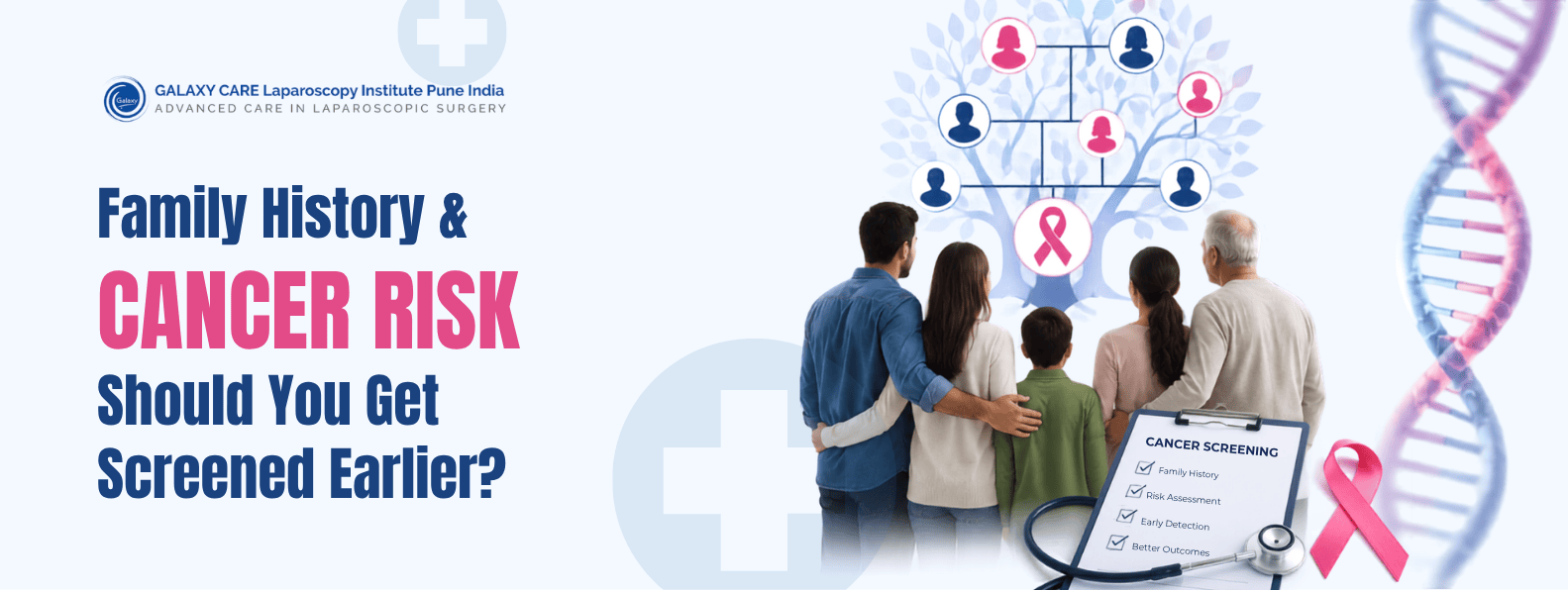
Family History and Cancer Risk: Should You Get Screened Earlier?
If someone in your family has had cancer, it’s natural to wonder what that means for your own health.
You may be wondering, “Does having a relative with cancer mean I’ll get it too?” The short answer is: not necessarily. But you need a proactive cancer screening routine. Cancer is complex. Most cases arise from a mix of gene lifestyle, and environment. However, when cancer shows up repeatedly in a family, especially at younger ages or in multiple close relatives, it can signal an inherited pattern worth paying attention to. That’s what we mean when we talk about family cancer history: a pattern of cancer diagnoses among blood relatives that may point to shared genetic traits or risk factors.
According to the National Cancer Institute, up to 10% of all cancers may be caused by inherited genetic changes, making hereditary cancer a small but critically important subset of overall cancer burden. This isn’t about alarm. It’s about awareness.
How Does Family History Affect Cancer Risk?
Here’s something many people don’t realize: your genes are essentially a biological blueprint passed down through generations. Some gene mutations, such as BRCA1, BRCA2, or Lynch syndrome genes, can significantly increase the likelihood of developing certain cancers. When these mutations run in families, they can raise an individual’s inherited cancer risk well above the general population average.
That said, inheriting a gene mutation doesn’t guarantee you’ll develop cancer. Think of it this way: a family history is a signal, not a sentence. It simply means your body may need a closer eye and a more personalized healthcare plan.
The best cancer specialists generally consider your family cancer risk to be elevated if:
- A first-degree relative (parent, sibling, or child) has been diagnosed with cancer
- Multiple relatives on the same side of the family have had cancer
- A relative was diagnosed at an unusually young age (e.g., breast cancer before age 50)
- The same type of cancer appears across multiple generations
- A male relative has had breast cancer (rare, but significant)
At Galaxy Care Hospital, Pune, our oncology team, led by Dr. Shailesh Puntambekar, a globally recognized cancer surgeon and pioneer in robotic and laparoscopic cancer surgery, routinely guides patients through understanding their genetic cancer risk and planning personalized screening plans.
Which Types of Cancer Are More Likely to Run in Families?
Not all cancers have the same hereditary links. Let’s look at why this matters for specific cancer types.
1. Breast Cancer
One of the most well-known hereditary cancer types. Mutations in the BRCA1 and BRCA2 genes can substantially raise the risk of breast and ovarian cancer. According to the National Cancer Institute, more than 60% of women who inherit a harmful change in BRCA1 or BRCA2 will develop breast cancer during their lifetimeIf. If your mother, sister, or daughter has had breast cancer, speak with your doctor about earlier or more frequent mammograms and possible genetic testing for cancer.
2. Colorectal Cancer
Conditions like Lynch syndrome and familial adenomatous polyposis (FAP) are well-established hereditary cancer syndromes that can run in families and dramatically increase the risk of colorectal cancer. Standard cancer screening guidelines typically recommend beginning colonoscopies at age 45, but those with a strong family history may be advised to start at 40 or even earlier.
3. Ovarian Cancer
Often called a “silent” cancer because symptoms appear late, ovarian cancer has strong ties to BRCA gene mutations. Women with a close relative who had ovarian cancer should discuss risk-reducing strategies and surveillance options with their gynecologist or oncologist. This is a situation where cancer screening for family history becomes especially vital.
4. Prostate Cancer
Men with a father or brother diagnosed with prostate cancer, particularly before age 65, have a notably higher genetic cancer risk themselves. Early conversations with a doctor about PSA testing are especially important for this group.
Should You Get Screened Earlier for Cancer?
Absolutely! Early cancer detection can genuinely save lives. When cancer is found early, treatment is typically more effective, less invasive, and associated with much better outcomes.
Standard cancer screening guidelines are designed for the general population. But if your family cancer history places you in a higher-risk category, your doctor may recommend:
- Starting screenings at a younger age than the general guidelines suggest
- Screening more frequently than the standard interval
- Using more sensitive imaging methods (e.g., MRI in addition to mammography)
- Undergoing genetic testing for cancer to better understand your inherited cancer risk
This isn’t about being anxious. It’s about being smart. Catching something early when it’s most treatable is one of the most powerful health decisions you can make.
At Galaxy Care Hospital, our multidisciplinary cancer care team evaluates each patient’s family history and designs individualized screening plans, ensuring no warning sign goes unnoticed.
When to Seek Genetic Counseling
If your family history is particularly concerning, genetic counseling may be worth exploring. Our cancer doctor in Pune can help you understand your inherited cancer risk, explain what genetic testing for cancer can and cannot tell you, and guide you through the decision-making process.
If a hereditary cancer syndrome is suspected, genetic counseling becomes especially important. Consider seeking it if:
- Several close relatives have had the same type of cancer
- Relatives were diagnosed at unusually young ages
- You have relatives with rare cancers (e.g., male breast cancer)
- You are of Ashkenazi Jewish descent (which carries higher BRCA mutation rates)
- A family member has already tested positive for a gene mutation
At Galaxy Care Hospital, our oncologists in Pune work closely with patients to assess whether genetic counseling and testing are appropriate, providing clear guidance every step of the way. Dr. Shailesh Puntambekar and his team bring decades of clinical experience in managing hereditary and complex cancer cases, making Galaxy Care a trusted destination for cancer care in Pune and beyond.
The Bottom Line
A family cancer history does not write your future. What it does is give you the opportunity to be more informed, more proactive, and more prepared than you might otherwise be. Early cancer detection remains one of the most powerful tools in modern medicine. A conversation with your cancer doctor, armed with your family’s health history, could be one of the most valuable health decisions you ever make.
If you’re based in Pune or anywhere in India and are concerned about your hereditary cancer risk, the expert oncology team at Galaxy Care Hospital is here to help. Under the leadership of Dr. Shailesh Puntambekar, our hospital offers advanced cancer screenings and world-class cancer treatment, cancer recovery and care, all under one roof
You don’t have to navigate this alone. Whether it’s scheduling a check-up, asking about genetic testing for cancer, or simply making one healthier choice today, every step matters. Your health story is still being written, and you have more say in it than you might think.
Discuss your cancer and family history concerns with Dr. Shailesh Puntambekar