Cancer Stage 1 vs Stage 4 Explained In Detail
Hearing the word “cancer stage” after diagnosis can be overwhelming. In the middle of appointments, reports, and medical terminology, it’s easy to feel like the information is coming faster than you can process it.
At Galaxy Care Hospital, we understand how confusing a cancer diagnosis and stagine can feel. This is why we are here to explain what cancer staging actually means, what separates an early stage from an advanced one, and why this single piece of information plays such a key role in treatment planning. Our goal is to help you feel informed from day one of your cancer diagnosis.
What are cancer stages?
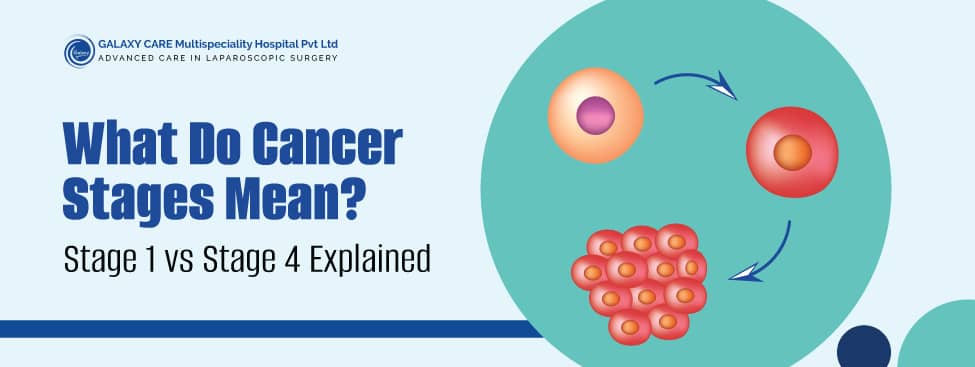
Cancer staging is the method doctors use to describe how much cancer is present in the body and where it is located. It is essentially a clinical snapshot taken at the time of diagnosis, and it becomes the foundation for every decision that follows.
Most staging systems rely on the TNM framework. T describes the size of the primary tumor. N indicates whether nearby lymph nodes are involved. M shows whether the cancer has spread to distant organs. Together, these factors determine the overall stage, typically expressed as a number from 1 to 4.
Staging exists because treatment cannot be one size fits all. It allows a cancer specialist to recommend the most appropriate course of action, anticipate how the disease is likely to behave, and monitor progress with greater precision. Two patients with the same type of cancer, but different stages, may require entirely different treatment strategies.
What do stage 1,2,3,4 cancer mean?
Let’s first understand what happens between Stage 1 and Stage 4, as it helps put a cancer diagnosis into context. However, it’s important to know that cancer staging actually begins at Stage 0, a fact that many people are unaware of. Understanding each stage can make it easier to understand the diagnosis and the treatment options that follow.
Stage 0: It refers to abnormal cells that have not spread beyond where they were found. This is considered a precancerous condition rather than cancer itself.
Stage 1: It indicates a small, localized tumor with no involvement of lymph nodes or other organs. Treatment at this stage is often the most straightforward, and outcomes tend to be favorable.
Stage 2: It describes a tumor that has grown further or extended into nearby tissue, sometimes with limited lymph node involvement. Treatment usually remains focused on a single region of the body.
Stage 3: It involves a larger tumor with more significant spread to nearby lymph nodes or surrounding structures. While it has not yet reached distant organs, treatment is typically more intensive due to a higher risk of further progression.
Stage 4: It is the most advanced stage, where cancer has reached distant organs or tissues, also referred to as cancer spread. At this point, treatment goals often shift.
Cancer stages are part of a gradual progression, not separate categories. The exact stage depends on each person’s individual diagnosis. If you or your loved one is seeking expert cancer treatment in Pune, feel free to consult Dr. Shailesh Puntambekar at Galaxy Care Hospital.
What is the difference between Cancer Stage 1 and Stage 4 ?
This comparison is often the first question patients and families ask, and it deserves a clear, direct answer.
Stage 1 cancer is confined to its point of origin, with no lymph node or distant organ involvement. Surgery is often sufficient on its own, sometimes supported by additional therapy to reduce the risk of recurrence.
Stage 4 cancer has spread beyond its original site, which usually means a single treatment is not enough. Care typically involves a combination of therapies, and the approach shifts from targeting one location to managing the disease across multiple areas of the body.
It is important to note that staging describes the extent of disease, not the individual patient. Age, general health, how the body responds to treatment, and the specific biology of the cancer all influence outcomes as much as the stage itself. Two patients with an identical diagnosis can experience very different journeys.
How do cancer specialists determine the stage of cancer?
Finding out the accurate cancer stage requires several diagnostic tools working together, not a single test.
The process typically begins with a physical examination to check for lumps or abnormalities. Imaging studies such as CT scans, MRIs, or PET scans are then used to assess tumor size and check for spread. A biopsy, in which a tissue sample is examined under a microscope, confirms the exact type of cancer. Blood tests provide additional information, including relevant tumor markers and organ function.
Once these findings are gathered, a cancer specialist reviews the complete clinical picture rather than relying on a single result before assigning a stage. This thorough approach is a core part of responsible oncology care, and it is closely tied to the value of routine cancer screening, which allows abnormalities to be identified before symptoms even appear.
Can stage 4 cancer be treated?
Yes. This is worth stating plainly, as many patients assume an advanced stage 4 leaves no treatment options. That assumption is incorrect.
What often changes at Stage 4 is the goal of treatment rather than its availability. In some cases, the focus shifts toward controlling disease progression, managing symptoms, and preserving quality of life. In others, newer approaches such as targeted therapy and immunotherapy have enabled meaningful disease control over extended periods. Chemotherapy and radiation continue to play significant roles, and surgery may still be considered in select cases to relieve complications or reduce tumor burden.
Cancer treatment has improved a lot over the years. Today, patients have access to many treatment options that were not available even 10 years ago. These treatments can help control the disease, reduce symptoms, improve quality of life
When should you consult a cancer specialist?
The sooner the better! Early cancer detection expands the range of available treatment options and improves overall prognosis.
You don’t need to have a confirmed cancer diagnosis before seeing a cancer specialist. If you notice symptoms like unexplained weight loss, constant tiredness, a new lump, changes in bowel or bladder habits, ongoing pain, or unusual bleeding, don’t ignore them. Getting checked early can make a real difference. Regular cancer screenings, based on your age and family history, can also help detect problems before symptoms appear.
Cancer stage is information, not a verdict
A cancer stage reflects where the disease stands at the time of diagnosis. It does not determine the outcome of a patient’s journey. Two individuals with the same cancer diagnosis and stage can experience very different paths, shaped by their overall health, how they respond to treatment, and the expertise of the team providing their care. Every cancer journey is different, and treatment outcomes depend on many factors, including the type of cancer, overall health, and how the body responds to treatment.
If you’re looking for timely diagnosis, expert guidance, and advanced cancer care, Galaxy Care Hospital, a trusted cancer hospital in Pune, provides personalized treatment plans tailored to each patient’s needs. Remember, a cancer stage is just one part of the diagnosis. What truly matters is getting the right care at the right time with cancer experts by your side.